- Open:Weekdays: 8:30 am – 5:30 pm, Saturdays: 9:00 am-2:00 pm
- Email: info@youdrugmart.com
- Follow:
-

-


Topical acne medication offers one of the most practical ways to treat mild to moderate acne, and many people prefer it because they can apply the medicine directly to affected skin. When choosing the best topical medication for acne, patients should consider the type of acne, skin sensitivity, age, pregnancy status, other ongoing medications, and the risk of scarring. In addition, some topical medicines treat acne while others treat fungal infections, eczema, dermatitis, or nail conditions, so patients should not use every topical medication interchangeably. This guide explains topical medication for acne, compares topical and oral treatment, and discusses who can safely use these medicines.
Topical acne medication refers to a medicine that patients apply directly to the skin. These products can come as gels, creams, lotions, solutions, washes, or other formulations.
Dermatologists use topical medication because different active ingredients target different causes of acne. For example, retinoids help prevent clogged pores, benzoyl peroxide reduces acne-causing bacteria and inflammation, salicylic acid helps unclog pores, and azelaic acid can reduce inflammation while also helping with post-acne dark spots.
Therefore, the best topical medication for acne does not necessarily mean the strongest product. Instead, the best option should match the patient’s specific acne pattern and tolerance.
| Biological Stage | Action Mechanism | Treatment Outcome |
| Stage 1: Application | You smooth the products over clean, dry skin. | Active compounds penetrate pores directly at the site of breakout. |
| Stage 2: Pore Unclogging | Salicylic acid or retinoids dissolve dead skin cell buildup inside follicles. | Reduces blackheads, whiteheads, and microcomedones effectively. |
| Stage 3: Bacterial Reduction | Benzoyl peroxide or topical antibiotics eliminate acnes bacteria rapidly. | Decreases localized inflammation, redness, and pus-filled lesions. |
| Stage 4: Skin Renewal | The medication accelerates cell turnover and regulates oil output. | Delivers smooth skin and results show over time. |
Available in 2.5–10% strengths (Benzagel, Proactiv, etc.).
Benzoyl peroxide remains one of the most widely used forms of topical medications. It reduces acne-causing bacteria and can help treat inflammatory pimples.
The best topical medication for acne for a person with mild inflammatory pimples may include benzoyl peroxide, particularly when the patient also needs an antibacterial component.
Benzoyl peroxide comes in several concentrations. Higher concentration does not automatically produce better results, and stronger products can increase dryness, irritation, peeling, and redness.
Differin 0.1% gel/cream is sold OTC in Canada. Higher strength 0.3% remains prescription‑only.
Adapalene represents another important topical acne medication. It belongs to the retinoid family and helps prevent clogged pores while treating blackheads, whiteheads, and inflammatory acne.
For many patients with comedonal acne (Comedonal acne develops when clogged hair follicles create non‑inflamed bumps called comedones), dermatologists consider a topical retinoid an important component of the best topical medication for acne regimen.
All strengths (0.01–0.1%) require a prescription.
Tretinoin represents a prescription retinoid that doctors commonly use for acne. It helps normalize follicular cell turnover and prevents new comedones.
For selected patients, tretinoin can become part of the best topical medication for acne plan, particularly when comedones dominate.
However, tretinoin can cause dryness, peeling, redness, and irritation, especially during the first several weeks. Therefore, patients should follow the prescribed strength and frequency rather than applying more medicine in an attempt to speed up results.
15% Finacea → Prescription
10% cosmetic azelaic acid (The Ordinary, Paula’s Choice) → OTC, but not classified as a drug.
Azelaic acid provides another useful topical acne medication option. It can reduce inflammation, help unclog pores, and improve dark marks that remain after acne.
Therefore, azelaic acid may serve as the best topical medication for acne for some patients who experience both acne and post-inflammatory hyperpigmentation.
Commonly available in 0.5–2% strengths (Clearasil, Oxy, etc.).
Salicylic acid provides an accessible topical medication option. It helps exfoliate the skin and unclog pores, making it particularly useful for blackheads and whiteheads.
Because many salicylic acid products come in washes and other nonprescription formulations, patients can find them more easily than prescription retinoids.
Always prescription‑only; antibiotic monotherapy discouraged.
Topical clindamycin can reduce inflammation and acne-associated bacteria.
However, doctors should not use topical antibiotics as the only long-term acne treatment. The American Academy of Dermatology recommends combining topical antibiotics with benzoyl peroxide to reduce the risk of antibiotic resistance.
Consequently, topical clindamycin may become part of the best topical medication for acne plan for selected inflammatory acne patients, but patients should use it under appropriate medical guidance.
All fixed‑dose combinations are prescription‑only, including:
Combination products can combine different mechanisms in one topical acne medication. For example, dermatologists may combine adapalene with benzoyl peroxide, or adapalene with clindamycin. Combination treatment can target several acne mechanisms simultaneously.
For some patients, combination treatment can represent the best topical medication for acne approach because one product can target multiple mechanisms. Nevertheless, patients still need to consider irritation, antibiotic exposure, and the specific type of acne.
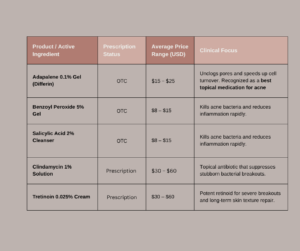
Finding the perfect topical medication requires balancing clinical efficacy with your monthly budget. The following table highlights popular over-the-counter and prescription options:
Budget-conscious shoppers frequently select OTC adapalene as the best topical medication for acne because it delivers prescription-strength retinoid performance at an accessible price point.
For mild acne, topical acne medication often provides an appropriate first-line approach. Dermatologists commonly use topical retinoids, benzoyl peroxide, salicylic acid, azelaic acid, and selected combination therapies.
However, moderate to severe acne may require oral treatment. Doctors may prescribe oral antibiotics, hormonal therapy for selected patients, or isotretinoin for severe or treatment-resistant acne.
Many teenagers and adults can use topical medication, provided they use the correct product and follow appropriate instructions.
However, certain groups need additional caution.
People with very sensitive or damaged skin may experience significant irritation. Patients with eczema or a compromised skin barrier may also need gentler treatment.
Furthermore, people taking other dermatologic medications should avoid randomly combining multiple active ingredients because excessive irritation can worsen the skin.
Patients should also understand that the best topical medication for acne for one person may cause severe irritation in another.
Pregnancy represents one of the most important situations that requires medication review.
The American Academy of Dermatology recommends avoiding topical retinoids such as tretinoin, tazarotene, and adapalene during pregnancy. It also recommends avoiding certain other acne medications such as Isotretinoin, Tazarotene, Spironolactone, Oral Tetracycline Antibiotics, High‑Dose Salicylic Acid and Oral Vitamin A Supplements, that can pose pregnancy risks.
Azelaic acid generally has a more favorable pregnancy safety profile, while benzoyl peroxide and limited salicylic acid use may be considered in selected situations after discussion with an obstetrician or dermatologist.
Topical acne medication generally does not treat nail disorders. This distinction matters because patients sometimes use the term “topical medication” broadly.
Nail conditions require a diagnosis before treatment. Fungal nail infections, for example, may require specific topical antifungal medications or oral antifungal treatment depending on the extent of infection.
A topical antifungal can target fungal organisms, while an acne retinoid targets abnormal follicular keratinization. Therefore, these medicines have completely different purposes.
Consequently, topical medication should not become a substitute for an appropriate nail treatment.
Patients with thickened, discolored, brittle, painful, or detached nails should receive an appropriate assessment before starting treatment.
The broader category of topical medication includes many treatments beyond topical acne medication.
For example:
Therefore, patients should not assume that a product labeled “topical” will treat every skin problem.
Choosing the best topical medication for acne starts with identifying the type of acne.
For blackheads and whiteheads, a retinoid or salicylic acid may help.
Similarly, for inflammatory pimples, benzoyl peroxide and appropriate combination therapy can help.
Azelaic acid may offer an additional benefits for acne associated with dark marks.
Likewise, for more extensive inflammatory acne, doctors may combine topical treatment with oral therapy.
In conclusion, the best medication should address the dominant acne mechanism without causing unnecessary irritation.
Patients should also remember that acne treatment requires patience. Dermatologists often recommend giving a treatment several weeks to work rather than changing products every few days.
Start with clean, dry skin unless the product instructions specify otherwise.
Apply the prescribed or recommended amount rather than assuming that more medicine will produce faster results. In fact, excessive application can cause irritation without accelerating acne clearance.
Use moisturizer when necessary, especially if a retinoid or benzoyl peroxide causes dryness.
Also, use broad-spectrum sunscreen during the day, particularly when your treatment increases skin sensitivity.
Avoid aggressive scrubbing because irritation can worsen acne.
Most importantly, do not combine several strong active ingredients without understanding how they interact.
From a clinical perspective, the best topical medication for acne depends less on the brand name and more on the active ingredient, acne severity, skin tolerance, and patient’s medical circumstances.
In conclusion, Canada’s federal rules give buyers clear advantages when choosing topical acne treatments. Health Canada enforces the Food and Drugs Act and Acne Therapy Monograph, which require every acne product to prove its safety, ingredient accuracy, and concentration limits before sale. Products must carry a DIN or NPN, so buyers can quickly confirm they’re purchasing a regulated, tested, and properly labeled medication rather than an unverified cosmetic. This framework helps shoppers trust that OTC options like benzoyl peroxide, salicylic acid, and adapalene meet national quality standards.

