- Open:Weekdays: 8:30 am – 5:30 pm, Saturdays: 9:00 am-2:00 pm
- Email: info@youdrugmart.com
- Follow:
-

-


Retatrutide Vs Ozempic is becoming a major topic in metabolic health because patients want clear, evidence‑based insight into how these medications differ. Retatrutide, Eli Lilly’s investigational “triple agonist,” is drawing attention for its early clinical results. Therefore, many people are now searching for Retatrutide as a strong appetite‑control alternative to Ozempic, and a deeper Retatrutide and Ozempic Comparison.
Ozempic already reshaped how patients think about diabetes, weight loss, and metabolic regulation; however, retatrutide works through additional pathways, which may lead to different outcomes. Even so, expectations should remain balanced because Ozempic is approved and widely used. In contrast, Retatrutide is still investigational and undergoing evaluation. Let’s take a deeper dive into Retatrutide and Ozempic Comparison to help patients understand how these two metabolic treatments differ.
To compare Retatrutide vs Ozempic, let’s understand in brief, what each one is.
Ozempic is the brand name for semaglutide, a once-weekly injectable GLP-1 receptor agonist. FDA approves it to improve blood sugar control in adults with type 2 diabetes and to reduce certain cardiovascular and kidney-related risks.
Ozempic works by mimicking GLP-1, a natural hormone involved in insulin release, glucagon suppression, appetite regulation, and delayed gastric emptying. These effects help lower blood sugar and often reduce appetite, which is why weight loss commonly occurs during treatment.
Retatrutide on the other hand, is Eli Lilly’s investigational once-weekly injectable medication. It has the capability to activate three receptors – GIP, GLP-1, as well as glucagon. Therefore, it is a triple hormone receptor agonist
This makes it different from Ozempic, which mainly targets GLP-1 receptors.
Secondly, FDA has not yet approved Retatrutide for public use. Its availability depends on the results of ongoing clinical trials and regulatory review.
Ozempic contains semaglutide, a GLP-1 receptor agonist.
Retatrutide is a single investigational molecule that activates GIP, GLP-1, and glucagon receptors. It is a triple agonist.
When comparing Retatrutide Vs Ozempic this composition matters, because the body uses these hormone pathways differently. To explain, GLP-1 mainly affects appetite, insulin release, glucagon suppression, and stomach emptying. On the other hand, GIP is involved in insulin secretion and metabolic regulation. Likewise, Glucagon receptor activity may influence energy expenditure. This multifunctioning impact makes Retatrutide a compelling focus in obesity research, especially as experts continue exploring its role in broader Retatrutide Vs Ozempic Comparison.
Ozempic works as a single-receptor GLP-1 agonist. It helps the pancreas release insulin when blood sugar is high, reduces glucagon secretion, slows stomach emptying, and reduces appetite.
In contrast, Retatrutide works more broadly. It activates GLP-1, GIP, and glucagon receptors. In preclinical models, retatrutide reduced food intake and increased energy expenditure, with the energy-expenditure effect attributed to glucagon receptor agonism.
Ozempic mainly reduces appetite and improves blood‑sugar control by activating the GLP‑1 pathway. In contrast, researchers study Retatrutide as a medication that may influence appetite, metabolism, and energy use through three distinct hormone pathways.
Ozempic supports weight loss by reducing appetite and improving blood‑sugar control, yet it is not the semaglutide brand approved specifically for chronic weight management. It still remains primarily a diabetes medication. However, Wegovy uses semaglutide at obesity‑focused doses. Therefore, researchers often compare Ozempic with Wegovy when discussing Retatrutide Vs Ozempic weight loss efficacy.
Retatrutide’s reported weight‑loss results appear larger in clinical trials, and Lilly reported that participants in the TRIUMPH‑1 Phase 3 obesity study lost significant weight with the 12 mg dose. In that group, patients lost an average of 70.3 lb, or 28.3% of body weight, over 80 weeks; 45.3% achieved at least 30% weight loss, which highlights why experts continue exploring broader Retatrutide and Ozempic Comparison discussions.
However, if researchers confirm these findings through full published data and regulatory review, retatrutide could emerge as one of the most powerful obesity‑treatment medications. Even so, trial outcomes do not always translate perfectly to everyday practice because adherence, side effects, access, diet, physical activity, and cost all influence real‑world results.
Ozempic commonly causes gastrointestinal side effects such as nausea, vomiting, diarrhea, constipation, and abdominal discomfort. This is because it slows gastric emptying and activates the GLP‑1 pathway, which directly affects digestion. Serious warnings include pancreatitis, gallbladder disease, kidney problems related to dehydration, and thyroid C-cell tumor warnings in labeling.
Similarly, reports indicate that Retatrutide’s also cause similar gastrointestinal side effects such as nausea, diarrhea, vomiting, and constipation. This is because it stimulates multiple hormone pathways that influence appetite, digestion, and metabolic regulation.
However, because retatrutide also activates glucagon receptors, its long-term safety profile will need careful evaluation. The key question is not only whether patients lose more weight, but whether the medication remains safe, tolerable, and sustainable over years.
If the FDA approves Retatrutide, it could reshape obesity treatment because early data suggest unusually strong weight‑loss outcomes. According to current speculation, its average weight‑loss results may reach levels historically associated with bariatric surgery. Lilly reported a 28.3% weight‑loss average at 80 weeks in a Phase 3 trial and up to 30.3% at 104 weeks among participants in an extension study with baseline BMI ≥35, which continues to fuel broader Retatrutide and Ozempic Comparison discussions.
That level of weight reduction could matter for patients with severe obesity, obesity‑related knee pain, fatty liver disease, diabetes risk, sleep apnea, or cardiovascular risk factors. However, stronger weight loss is not automatically better for every patient. In fact, some individuals may benefit from slower weight reduction, closer nutritional monitoring, muscle‑preservation strategies, or dose adjustments.
From a physician’s perspective, the arrival of a more potent medication would not replace individualized care. Instead, doctors will dive deeper into Retatrutide Vs Ozempic comparison to prescribe the most appropriate treatment.
Ozempic may be better for patients with type 2 diabetes who need blood sugar improvement and cardiovascular risk reduction according to approved indications. It may also be used off-label for weight loss in some settings, but patients should understand that its official approval is diabetes-focused.
Retatrutide on the other hand, if approved, may be more relevant for patients whose main clinical issue is weight related complications, especially if they need substantial weight loss. However, this depends on future approved indications, prescribing rules, contraindications, and long-term safety data.
Patients with prior pancreatitis, gallbladder disease, severe gastrointestinal disease, thyroid cancer-related contraindications, pregnancy, eating-disorder risk, or complex medication histories would need more tailored evaluation before using either type of medication.
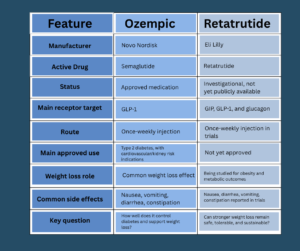
Feature | Ozempic | Retatrutide |
| Manufacturer | Novo Nordisk | Eli Lilly |
| Active drug | Semaglutide | Retatrutide |
| Status | Approved medication | Investigational, not yet publicly available |
| Main receptor target | GLP-1 | GIP, GLP-1, and glucagon |
| Route | Once-weekly injection | Once-weekly injection in trials |
| Main approved use | Type 2 diabetes, with certain cardiovascular/kidney risk indications | Not yet approved |
| Weight-loss role | Common weight loss effect; obesity brand is Wegovy | Being studied for obesity and metabolic outcomes |
| Common side effects | Nausea, vomiting, diarrhea, constipation | Nausea, diarrhea, vomiting, constipation reported in trials |
| Key question | How well does it control diabetes and support weight loss? | Can stronger weight loss remain safe, tolerable, and sustainable? |
Not necessarily. If FDA approves retatrutide, it may become a major obesity-treatment option. However, Ozempic will likely remain important for type 2 diabetes and cardiometabolic care.
A new medication does not automatically replace an older one. Some patients may respond better to semaglutide. Others may tolerate triple‑agonists. In short, Retatrutide may expand treatment choices rather than eliminate the need for Ozempic.
In conclusion, the most accurate assessment is this: Ozempic remains an established, approved, and widely accessible treatment, while retatrutide is promising, biologically more complex, and still under investigation. As clinicians continue deeper Retatrutide Vs Ozempic evaluations, each medication will ultimately serve different patient groups with distinct needs, conditions, and treatment goals.