- Open:Weekdays: 8:30 am – 5:30 pm, Saturdays: 9:00 am-2:00 pm
- Email: info@youdrugmart.com
- Follow:
-

-


An acne medication prescription can include a topical treatment, an oral medication, or a combination of both, depending on the type and severity of acne. Understanding common acne medication options and acne medication names can help patients understand why a dermatologist chooses one treatment over another, how long treatment may take, and when treatment needs to be escalated.
Acne develops through several processes, including clogged pores, excess oil production, inflammation, and changes involving Cutibacterium acnes. Therefore, no single medication works best for every patient. The American Academy of Dermatology recommends several topical and systemic options, including retinoids, benzoyl peroxide, antibiotics, clascoterone, azelaic acid, doxycycline, minocycline, sarecycline, spironolactone, combined oral contraceptives, and isotretinoin.
Before explaining the popular acne medication names, let’s understand how we categorize them as topical or oral medications. The first major distinction involves how the acne medication prescription reaches the body.
Topical acne medication goes directly onto the skin. Dermatologists commonly use topical treatment for mild to moderate acne, although they may also combine it with oral treatment for more severe disease.
Oral acne medication travels through the bloodstream and can treat acne more broadly. Dermatologists may consider oral therapy when acne becomes moderate to severe, affects extensive areas, produces painful inflammatory lesions, or fails to respond adequately to topical treatment.
Importantly, oral treatment does not replace topical treatment in every situation. Instead, dermatologists often combine medications that target different causes of acne.
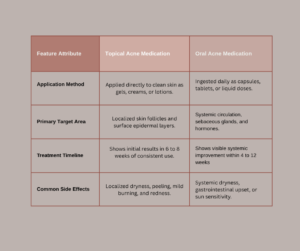
| Feature Attribute | Topical Acne Medication | Oral Acne Medication |
| Application Method | Applied directly to clean skin as gels, creams, or lotions. | Ingested daily as capsules, tablets, or liquid doses. |
| Primary Target Area | Localized skin follicles and surface epidermal layers. | Systemic circulation, sebaceous glands, and hormones. |
| Treatment Timeline | Shows initial results in 6 to 8 weeks of consistent use. | Shows visible systemic improvement within 4 to 12 weeks. |
| Common Side Effects | Localized dryness, peeling, mild burning, and redness. | Systemic dryness, gastrointestinal upset, or sun sensitivity. |
Tretinoin is a topical retinoid that helps prevent clogged pores and promotes more normal follicular cell turnover. It can treat blackheads, whiteheads, and inflammatory acne. Because tretinoin can cause dryness, peeling, and irritation, dermatologists often introduce it gradually. Patients commonly apply it in the evening and use sunscreen during the day.
Adapalene is one of the most popular acne medication names under the topical retinoid. It helps prevent clogged pores and can treat both comedonal and inflammatory acne. Adapalene is available without a prescription in some markets, while stronger or combination formulations may require a prescription.
Tazarotene is a prescription topical retinoid that can effectively treat acne by regulating abnormal follicular cell turnover. However, it can cause significant irritation, particularly when patients apply too much or use it too frequently.
Trifarotene is a newer topical retinoid that can treat acne on both the face and trunk. Therefore, it can be particularly useful for patients with significant back or chest acne.
Benzoyl peroxide reduces acne associated bacteria and inflammation. It also plays an important role when clinicians prescribe antibiotics because it helps reduce the risk of antibiotic resistance. Patients can find benzoyl peroxide in cleansers, washes, creams, gels, and combination prescription products.
Clindamycin is a topical antibiotic used primarily for inflammatory acne. However, patients should not use topical clindamycin as a long term stand alone treatment. Dermatologists generally combine topical antibiotics with benzoyl peroxide to reduce antibiotic resistance.
Azelaic acid can unclog pores, reduce inflammation, and act against acne associated bacteria. It also has an additional benefit because it can help improve dark spots left after acne heals. Consequently, azelaic acid can work particularly well for patients who have both active acne and post inflammatory hyperpigmentation.
Salicylic acid helps exfoliate the skin and unclog pores. It can benefit patients with blackheads, whiteheads, and some inflammatory lesions. However, excessive use can cause irritation, particularly when patients combine salicylic acid with several other active ingredients.
Clascoterone represents a newer topical option for acne with a hormonal component. It works by blocking androgen receptors in the skin. The AAD includes clascoterone among recommended topical acne treatments.
When topical treatment does not provide enough control, a dermatologist may prescribe oral acne medication. Here are some popular oral acne medication names.
Doxycycline is a commonly used oral antibiotic for moderate to severe inflammatory acne. It reduces inflammation and bacterial activity.
However, dermatologists generally prescribe antibiotics for the shortest practical duration rather than using them indefinitely. The AAD notes that treatment commonly lasts several months, often around three to four months, depending on the patient’s response.
Minocycline is another oral tetracycline antibiotic used for inflammatory acne. Although it can be effective, it has its own adverse effect profile, including dizziness, gastrointestinal effects, pigmentation changes, and rare serious reactions. Therefore, the choice between minocycline and another antibiotic depends on individual factors.
Sarecycline is an oral tetracycline antibiotic specifically approved for acne. Like other oral antibiotics, it works mainly as part of a broader treatment plan rather than as indefinite maintenance therapy. The AAD lists doxycycline, minocycline, and sarecycline among systemic acne treatment options.
Spironolactone is one of the acne medication names that can help selected patients with hormonal acne. Dermatologists may consider it when acne repeatedly affects the lower face, chin, jawline, or neck, particularly when breakouts follow a menstrual pattern. Because spironolactone has antiandrogenic effects, clinicians need to consider pregnancy potential and other medical factors before prescribing it.
Certain combined oral contraceptives can improve hormonal acne. However, they do not suit everyone. Clinicians need to consider factors such as smoking, migraine history, cardiovascular risk, blood pressure, pregnancy, and other medications before prescribing them.

Navigating the long list of acne medication names helps you understand precisely how your prescribed acne medication functions. Doctors categorize these therapies into topical treatments and oral pills:
| Medication Name | Drug Class | Primary Mechanism | Best Used For |
| Tretinoin | Topical Retinoid | Accelerates cell turnover and prevents clogged pores. | Blackheads, whiteheads, and texture repair. |
| Adapalene | Topical Retinoid | Reduces inflammation and clears follicle blockages. | Mild to moderate comedonal and inflammatory acne. |
| Tazarotene | High-Potency Retinoid | Delivers deep cellular exfoliation. | Stubborn, persistent acne and post-inflammatory marks. |
| Clindamycin | Topical Antibiotic | Eliminates surface C. acnes bacteria directly. | Red, swollen inflammatory pimples. |
| Azelaic Acid | Dicarboxylic Acid | Kills bacteria while fading post-acne hyperpigmentation. | Sensitive skin, rosacea-prone skin, and dark spots. |
| Clascoterone | Topical Anti-Androgen | Blocks local androgen receptors in oil glands directly. | Hormonal breakouts in male and female patients. |
Acne Medication Names | Drug Class | Primary Mechanism | Best Used For |
| Doxycycline | Oral Antibiotic | Suppresses systemic bacterial growth and inflammation. | Moderate to severe inflammatory acne flares. |
| Minocycline | Oral Antibiotic | Decreases deep-tissue bacterial swelling rapidly. | Widespread inflammatory pustules and papules. |
| Sarecycline | Targeted Antibiotic | Provides narrow-spectrum antibiotic targeting for skin. | Inflammatory lesions with lower gut-microbiome impact. |
| Spironolactone | Oral Anti-Androgen | Reduces systemic androgen hormones that trigger oil. | Hormonal jawline and cystic acne in adult females. |
| Isotretinoin (Accutane) | Oral Retinoid | Shrinks oil glands permanently and normalizes turnover. | Severe, scarring, or treatment-resistant cystic acne. |
Each acne medication prescription targets a distinct step in breakout formation, making accurate diagnosis vital for long-term clearance.
Isotretinoin deserves special attention because it can treat severe acne when standard treatments fail. Dermatologists may recommend isotretinoin for severe nodular acne, significant scarring, or acne that has not responded adequately to topical and oral treatment. The AAD describes isotretinoin as one of the most popular acne medication names for severe acne.
Unlike topical retinoids, isotretinoin works throughout the body. It reduces sebaceous gland activity, decreases oil production, helps normalize follicular keratinization, and reduces inflammation. However, isotretinoin requires careful medical supervision. It can cause significant dryness and other adverse effects, and pregnancy prevention remains a critical safety issue because isotretinoin can cause severe fetal harm.
A dermatologist may escalate an acne medication prescription when:
However, escalation does not automatically mean isotretinoin.
For moderate inflammatory acne, a dermatologist may add an oral antibiotic while continuing topical treatment. On the contrary, for hormonal acne, spironolactone or a combined oral contraceptive may become appropriate. Similarly, for severe or treatment resistant acne, isotretinoin may become the preferred option.
Dermatologists follow a structured clinical pathway when managing persistent breakouts:
| Treatment Phase | Clinical Trigger | Escalation Action |
| Phase 1: Initial Topical Care | Mild to moderate comedonal or localized inflammatory acne. | Prescribe a topical retinoid paired with benzoyl peroxide or clindamycin. |
| Phase 2: Oral Antibiotic Addition | Moderate to severe widespread inflammatory lesions failing topicals after 8 weeks. | Add an oral tetracycline (such as doxycycline or sarecycline) for a short 3-to-4-month course. |
| Phase 3: Hormonal or Isotretinoin Step | Severe nodulocystic acne, scarring, or rapid relapse after oral antibiotics. | Transition the patient to oral spironolactone (for females) or oral isotretinoin for permanent remission. |
Evaluating these clinical shifts ensures you receive an acne medication prescription that matches your evolving skin needs.
One of the most important things patients should understand about acne medication is that improvement takes time.
Topical retinoids may initially cause dryness and irritation before patients see substantial improvement. Likewise, oral antibiotics require several weeks before their full effect becomes apparent.
The AAD notes that patients may need two to three months before they see meaningful improvement.
Acne has multiple causes, so dermatologists often combine medications with different mechanisms.
For example, a treatment plan may contain:
Retinoid + benzoyl peroxide: helps unclog pores while reducing acne associated bacteria.
Retinoid + topical antibiotic: targets clogged pores and inflammation while addressing bacterial activity.
Benzoyl peroxide + antibiotic: treats inflammatory acne while reducing antibiotic resistance.
Topical treatment + oral antibiotic: provides local treatment while controlling more extensive inflammatory acne.
The AAD specifically recommends combining different topical mechanisms and using benzoyl peroxide alongside antibiotics.
Clearing acne does not always mean that treatment should stop immediately.
Acne can recur because the underlying tendency to develop clogged pores and inflammation may persist.
While topical retinoids often serve as maintenance treatment after acne becomes controlled, it can also prevent new lesions and reduce the need for repeated systemic treatment.
Oral antibiotics, on the other hand, generally should not become indefinite maintenance therapy because prolonged antibiotic exposure increases concerns about resistance and other complications.
Patients should tell their physician about other medications, pregnancy, breastfeeding, allergies, and existing medical conditions before starting prescription acne treatment.
Pregnancy deserves particular attention because some acne medications, especially retinoids, can cause serious fetal harm.
Patients should also avoid randomly combining more than one strong acne medication prescription. For example, using a retinoid, benzoyl peroxide, salicylic acid, exfoliating acids, and harsh scrubs simultaneously can produce significant irritation without necessarily improving acne faster.
The long list of acne medication names reflects the fact that acne has different forms and severity levels.
Topical retinoids such as tretinoin, adapalene, tazarotene, and trifarotene primarily address clogged pores and support long term control. Benzoyl peroxide helps reduce acne associated bacteria and remains particularly important when antibiotics are prescribed. Clindamycin can treat inflammatory acne but should generally accompany benzoyl peroxide. Azelaic acid can treat acne while also helping dark marks, while clascoterone provides a topical approach to androgen related acne.
For more extensive inflammatory acne, oral acne medication such as doxycycline, minocycline, or sarecycline may become appropriate. Hormonal options such as spironolactone or combined oral contraceptives can benefit selected patients.
Finally, isotretinoin remains an important option for severe, nodular, scarring, or treatment resistant acne.
When patients ask about an acne medication prescription, the goal should not be to find the strongest medication available. Instead, the goal should be to identify the medication that best matches the patient’s acne type, severity, medical history, treatment goals, and tolerance.
The right acne medication should control existing lesions while preventing new breakouts and minimizing the risk of scarring. Most importantly, patients should give treatment enough time to work and should follow the prescribed regimen consistently.
If acne remains severe, painful, scarring, or resistant despite appropriate treatment, a dermatology assessment can help determine whether the patient needs a different acne medication prescription, combination therapy, hormonal treatment, an oral antibiotic, or isotretinoin.

