- Open:Weekdays: 8:30 am – 5:30 pm, Saturdays: 9:00 am-2:00 pm
- Email: info@youdrugmart.com
- Follow:
-

-


A vasovagal episode can feel frightening: One moment you stand in a hot line-up or watch a nurse draw your blood, and the next moment the room spins and you wake up on the floor. Naturally, most people then ask what causes a vasovagal episode, whether they need vasovagal episode treatment, and how to prevent a vasovagal attack. Fortunately, the answers are reassuring for most Canadians. In fact, fainting (doctors call it syncope, which means fainting or passing out in medical terms) accounts for about 1% of all emergency department visits in North America.
Moreover, research suggests that at least 32% to 35% of people will faint at some point in their lives. Researchers found that vasovagal fainting caused 68% of first-time fainting cases in a study of more than 9,000 British Columbia emergency department patients. Similarly, Canadian hospitals attribute only about 12% to 15% of fainting cases to a harmless cause.
In other words, if you have fainted, you are not the only one. Still, understanding your triggers gives you real control. Therefore, this guide explains what happens in your body, which everyday situations set off a vasovagal episode, and which simple steps help you prevent the next one.
Your vagus nerve runs from your brain to your heart, lungs, and gut. Normally, it helps slow your heart and keep you calm. However, in some people, certain triggers make this nerve overreact. As a result, your heart rate suddenly drops and the blood vessels in your legs widen. As a result, blood collects in your legs, your blood pressure drops, and your brain briefly receives less blood and oxygen. That is when you faint.
Importantly, a vasovagal episode is a reflex, not a disease of the heart or brain. Once you lie flat, blood returns to your head quickly, and most people wake up within seconds to a minute. For this reason, doctors often call it “reflex syncope” or “neurocardiogenic syncope.” Although a vasovagal attack rarely signals danger by itself, the fall can still cause injuries, so prevention matters.
Most people feel a warning phase, called a prodrome, before they pass out. In particular, watch for:
These signs usually last a few seconds to a minute. Fortunately, this short window gives you time to act. Specifically, if you recognize a vasovagal attack starting, you can sit or lie down right away and often stop it completely.
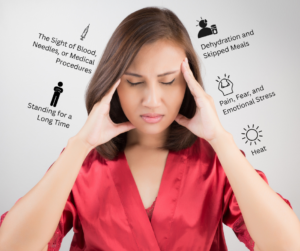
So, what causes a vasovagal episode in everyday life? Doctors group the triggers into a few main categories. Notably, the same person often responds to the same trigger repeatedly, so keeping track of your own pattern helps a lot.
If you wonder what causes a vasovagal episode at events or work, look first at standing. Prolonged standing ranks as one of the most common triggers. For example, a long church service, a crowded concert, a choir performance, or a soldier standing at attention can all set it off. When you stand still, gravity pulls blood into your legs. Without leg-muscle movement to push it back up, your blood pressure gradually drops, and eventually the reflex kicks in.
Heat widens your blood vessels, which lowers your blood pressure even further. Therefore, a hot shower, a sauna, a packed subway car, or a stuffy room makes a vasovagal episode more likely. Interestingly, many Canadians notice that they faint more often in summer heat waves or in overheated indoor spaces during winter.
Seeing blood, getting a needle, or undergoing a medical or dental procedure triggers many people. In fact, blood donation clinics and vaccine sites see this reaction regularly. Fear and anticipation alone can also start a vasovagal attack, even before the needle touches your skin. That is why nurses often ask you to lie down if you have fainted during a needle before.
Sudden pain, such as stubbing a toe or an injury, can trigger the reflex. Likewise, strong emotions, such as shock, fear, or bad news, can do the same. Anyone who asks what causes a vasovagal episode during stressful moments should know that the brain’s emotional centres feed directly into the vagus nerve.
Not drinking enough water is one of the most common triggers of a vasovagal episode. When you become dehydrated, the amount of blood circulating in your body drops. As a result, your body has a harder time keeping your blood pressure stable.
Other factors can also increase your risk. For example, skipping meals, exercising in hot weather, having vomiting or diarrhea from a stomach illness, or drinking alcohol can make a vasovagal episode more likely.
Some people faint only during specific body actions. For instance, doctors describe “situational syncope” after:
Because each of these actions stimulates the vagus nerve, each can lead to a vasovagal attack in susceptible people.
Standing up too fast, especially after lying down for a long time or after a hot bath, can also cause fainting. Strictly speaking, doctors call this “orthostatic” fainting, but it often overlaps with a vasovagal episode, and the prevention steps look very similar.

Knowing what causes a vasovagal episode is only part of the picture; your personal risk matters too. Anyone can faint; however, a vasovagal episode happens most often in teenagers and young adults, and it often runs in families. Additionally, women report it slightly more often than men. Pregnancy, low body weight, and certain medications that lower blood pressure can also increase your risk. Meanwhile, in older adults, doctors take fainting more seriously because heart problems become more common with age.

In most cases, your vasovagal episode pattern gives your doctor the answer. For example, a clear trigger, warning signs beforehand, and quick recovery all point toward a vasovagal episode. In addition, your doctor will usually check your blood pressure lying and standing and order an electrocardiogram (ECG) to look at your heart rhythm. Canadian emergency physicians also use a made-in-Canada tool, the Canadian Syncope Risk Score, to decide who can safely go home. Occasionally, if fainting keeps happening without a clear reason, your doctor may order a tilt-table test, a heart monitor, or an echocardiogram.
Good news: vasovagal episode treatment rarely needs pills or procedures. Instead, most people do well with education and simple habits. In fact, major syncope guidelines strongly recommend that doctors start by explaining the diagnosis and teaching patients to avoid their triggers.

The moment you feel a vasovagal attack coming on, act fast:
Above all, never try to “push through” the warning signs while standing, because that is when falls and injuries happen.
Counterpressure manoeuvres are one of the most effective forms of vasovagal episode treatment. These movements squeeze your muscles to push blood back toward your heart and brain. For example:
Remarkably, a multicentre trial of 223 patients found that patients trained in these manoeuvres had fewer recurrences than those who received usual care (about 32% versus 51% over 14 months). Consequently, many doctors now teach these manoeuvres as first-line vasovagal episode treatment for people who get warning signs.
Drinking more fluid, often about 2 to 3 litres a day, helps expand your blood volume. In addition, some doctors recommend adding a little more salt to your diet. However, you should not increase salt if you have high blood pressure, heart failure, or kidney disease, so always check with your doctor first. Notably, drinking about 500 mL of water quickly before a known trigger, such as a blood test, can also help.
For people with frequent episodes, some clinics teach “tilt training,” which means standing against a wall for gradually longer periods each day to train your reflexes. Similarly, waist-high compression stockings can reduce blood pooling in the legs.
When these steps fail, specialists sometimes prescribe medications. In fact, Canadian researchers in Calgary have led several major trials of drugs such as fludrocortisone and midodrine for recurrent fainting. Before you start any medication-based vasovagal episode treatment, your doctor will weigh the benefits and side effects. Rarely, older adults with very slow heart rates during a vasovagal episode may benefit from a pacemaker. Nevertheless, most people never need this level of vasovagal episode treatment.
Although most fainting is harmless, some warning signs need urgent care. Call 9-1-1 or go to the nearest emergency department if fainting comes with the following scenarios:
Additionally, book a visit with your family doctor after any first faint, even if you feel fine.
Canadian driving rules for fainting depend on the cause and your province. Generally, a single, clearly diagnosed vasovagal episode with an obvious trigger, especially while standing, does not prevent driving. However, recurrent or unexplained fainting can lead to restrictions. Therefore, ask your doctor about the rules that apply to you.
Doctors see many patients who arrive worried after a vasovagal attack. Often, they fear a heart problem or a seizure. Fortunately, once doctors review their story and run a few basic tests, most of them learn that they had a vasovagal episode, a common and usually harmless reflex. Nevertheless, doctors never dismiss fainting. Doctors first rule out any serious underlying heart problems. Then, they start the vasovagal episode treatment.
In a vasovagal episode treatment, doctors focus on three things. First, they help patients identify what causes a vasovagal episode in them. This is because knowing the triggers is winning half the battle. Second, they teach the warning signs so patients can take the right preventive actions during the prodromal phase. This may include drinking water, sitting down, or even using the counterpressure manoeuvres. The third step emphasizes on hydration and practical habits, which form the backbone of vasovagal episode treatment for nearly everyone.
In conclusion, take your body’s warning signs seriously, sit or lie down early, and never be embarrassed to tell a nurse or dentist that you faint easily. Finally, see your family doctor after any first faint, and seek urgent care if you notice any red-flag symptoms. With the right knowledge, most people prevent future episodes and live full, active lives.

